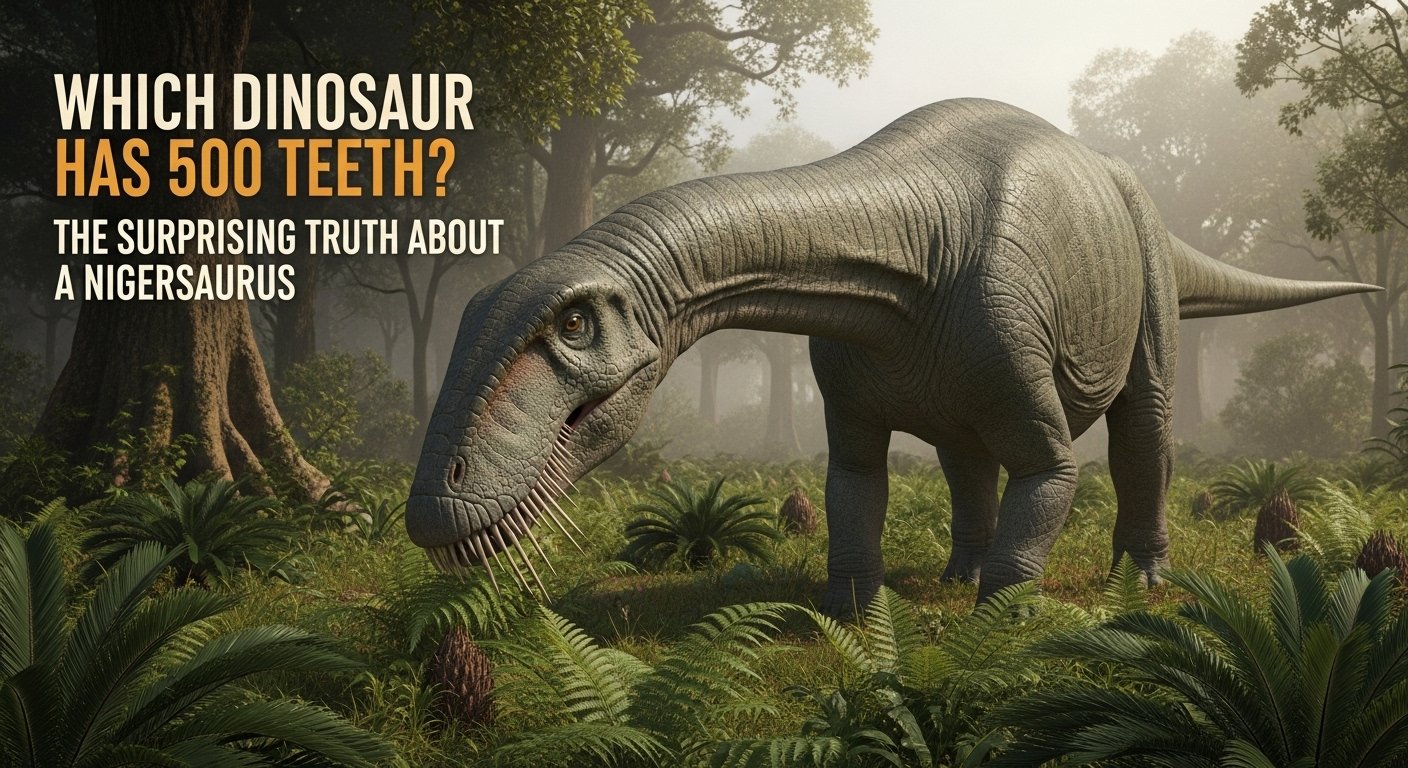
What Is Nigersaurus?
Nigersaurus was a type of sauropod dinosaur. Sauropods are the big, long-necked dinosaurs that ate plants. Think of relatives like Diplodocus or Brachiosaurus, but Nigersaurus was smaller and very different.
- It lived about 115 to 105 million years ago in the middle part of the Cretaceous period.
- Its name means “Niger lizard” or “Niger reptile.” It is named after the country Niger in Africa, where its fossils were found.
- The full scientific name is Nigersaurus taqueti, given to honor French paleontologist Philippe Taquet, who found early bones in the 1960s and 1970s.
Nigersaurus was not huge like some sauropods. It was about 30 feet (9 meters) long from head to tail — roughly the length of a school bus. It weighed around 2 to 4 tons, similar to a modern African forest elephant or Asian elephant. Its neck was shorter than many other sauropods, and its legs were strong to support its body.
Its body had air pockets in the bones (called pneumatized skeleton), which made it lighter. But its legs were thick and sturdy for walking on land.
The Surprising Discovery of Nigersaurus
The story of Nigersaurus starts in the hot Sahara Desert of Niger. In the 1960s, Philippe Taquet and his team found some strange bones in a place called Gadoufaoua, part of the Elrhaz Formation. These rocks come from ancient river areas full of life.
Many years later, in the late 1990s, American paleontologist Paul Sereno led teams back to Niger. They found more bones, including almost complete skulls and skeletons of adults and even baby Nigersaurus.
In 1999, Sereno and his team officially described and named Nigersaurus taqueti in a science paper. They called it one of the strangest dinosaurs they had ever seen. The skull was so delicate and full of big holes (fenestrae) that it looked light and weak — but it was perfect for its job.
Later finds in 2000 gave even more details. Today, we know Nigersaurus well because of these fossils. Paul Sereno has said it had the weirdest head of any dinosaur he studied.
Why Does Nigersaurus Have 500 Teeth? The Amazing Mouth
The most famous thing about Nigersaurus is its mouth — it had more than 500 teeth! That’s way more than any other dinosaur or animal we know.
Humans have 32 teeth. Sharks have many rows that replace, but Nigersaurus took it to another level.
- Its upper jaw had about 60 columns (rows) of small, needle-like teeth.
- Its lower jaw had about 68 columns of sharp teeth.
- Together, the active (working) teeth plus replacement teeth added up to over 500.
These teeth were not big and scary like a T. rex. They were small, thin, and sharp — like little needles or blades.
The teeth formed “dental batteries.” This means rows of teeth stacked like a conveyor belt. Behind each working tooth were up to 5–10 replacement teeth ready to move forward.
Experts say Nigersaurus replaced its teeth very fast — about every 14 days! Old teeth wore down from constant eating, so new ones pushed in quickly. This let it keep grazing without stopping.
Its jaws were wide and flat, like a shovel or vacuum cleaner. The tooth-bearing parts of the jaws were turned sideways so all teeth sat right at the front of the mouth. This is very unusual — no other animal has jaws quite like this.
Some scientists think its mouth had a keratin sheath (like a horny cover) for extra strength.
How Did Nigersaurus Eat With So Many Teeth?
Nigersaurus was a herbivore — it only ate plants. It did not eat meat or chase animals.
Its wide, straight-edged muzzle and hundreds of teeth were perfect for low grazing. It ate soft plants close to the ground, like ferns, horsetails, early flowering plants (angiosperms), and other low vegetation.
Experts compare it to a modern cow or a lawn mower:
- It lowered its head and swept its mouth side to side.
- The many small teeth sliced and shredded plants quickly.
- Its vacuum-like mouth sucked in lots of food at once.
Paul Sereno called it the “Mesozoic cow” because it grazed like cattle do today. Unlike tall sauropods that reached high trees, Nigersaurus stayed low to the ground.
Its eyes were on the sides of its head, so it could watch for danger while eating. Its light skull helped it move its head fast while grazing.
This special way of eating made Nigersaurus very successful in its environment.
Where Did Nigersaurus Live?
Nigersaurus lived in what is now the Sahara Desert in Niger, but back then it was very different. The area was a lush floodplain with rivers, forests, and lots of green plants. It was warm and wet, full of life.
It shared its home with other dinosaurs, crocodiles, fish, and flying reptiles. Fossils show it lived in groups or herds sometimes.
Its habitat was riparian (near rivers), so it had plenty of soft plants to eat.
Fun Facts About Nigersaurus
Here are some quick, true facts to remember:
- Nigersaurus had more teeth than any known dinosaur — over 500!
- It replaced teeth faster than almost any animal.
- Its skull was so thin and full of holes it was lighter than you think.
- It was about the size and weight of an elephant.
- It lived millions of years before famous dinosaurs like T. rex.
- Babies (hatchlings) have been found, showing it cared for young or laid eggs in groups.
- Its teeth were all at the front — no back teeth for chewing like we have.
Why Is Nigersaurus Famous Online? The Meme Story
You may have seen the question “Which dinosaur has 500 teeth?” as a joke or meme online. People say “Don’t Google it!” or make funny posts.
The joke started because the name “Nigersaurus” sounds a bit like a bad word when said wrong. (It is really pronounced “NEE-zhair-SORE-us” or “NYE-jer-SORE-us,” after the country Niger, which is “NEE-zhair.”)
The meme tricks people into looking it up, then they see the funny-sounding name and the crazy 500 teeth fact. It became popular on Reddit, TikTok, and other sites around 2019–2021.
But behind the joke is a real, amazing dinosaur. The meme helped more people learn about Nigersaurus and paleontology.
Why Nigersaurus Is Important to Science
Nigersaurus shows how different dinosaurs could be. Not all long-necked dinosaurs ate from trees. Some, like Nigersaurus, evolved special mouths for ground plants.
Its dental batteries are like those in later dinosaurs (hadrosaurs and ceratopsians), but Nigersaurus did it earlier. This helps scientists understand how teeth evolved for different diets.
Finding it in Africa also tells us more about dinosaurs on that continent during the Cretaceous.
Paleontologists like Paul Sereno continue to study it. Reconstructions and models show what it looked like — a weird, boxy head with a huge grin of tiny teeth.
Explore More: TikTok Coins: What They Are, How to Buy Them, and How They Work on TikTok
Final Thoughts
Nigersaurus is the surprising answer to “Which dinosaur has 500 teeth?” It was not a monster — it was a peaceful plant-eater with a one-of-a-kind mouth. Its 500+ teeth, fast replacement, and grazing style make it stand out among all dinosaurs.
Next time you see the meme, remember the real science: a 30-foot “Mesozoic cow” from ancient Africa that mowed lawns with its vacuum mouth!
This dinosaur teaches us that nature is full of strange and wonderful designs. Thanks to hard work by scientists in the desert, we now know its story.
About the Author

Mary Correa is a content writer with 9 years of experience. She loves writing about luxury villas and travel. Her articles are easy to read and full of exciting ideas. Mary helps readers discover amazing places to visit and stay. When she’s not writing, she enjoys exploring new destinations.