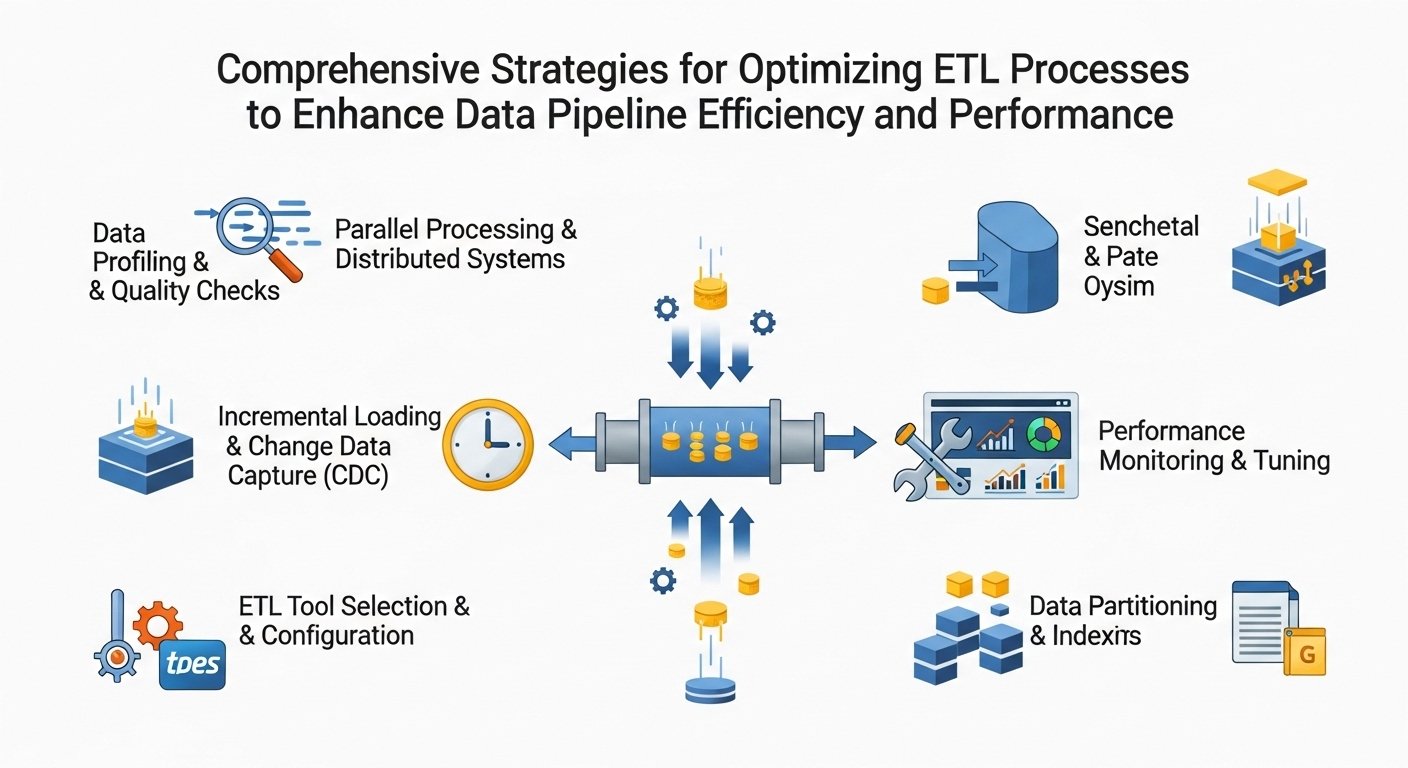
ETL stands for Extract, Transform, Load. It is a key process in data management. Companies use ETL to pull data from different sources, change it into a useful format, and put it into a data warehouse or database. When ETL runs slowly or uses too much resources, it creates problems like delayed reports, high costs, and frustrated teams.
In today’s world with big data growing fast, optimizing ETL is very important. Good optimization makes pipelines run faster, use less money, handle more data, and stay reliable. This article explains simple, step-by-step strategies to make your ETL processes better. We cover everything from basic ideas to advanced tips. Follow these to build strong, efficient data pipelines.
What Makes ETL Slow? Common Problems
Before we fix things, understand why ETL can be slow.
- Full data loads every time instead of only new changes.
- Too many steps done one after another without using multiple cores or machines.
- Large tables without splitting (partitioning).
- Bad queries that scan too much data.
- No good error checks or monitoring, so problems take long to find.
- Old tools that do not use modern cloud power.
These issues waste time and money. Now let’s see how to solve them.
1. Use Incremental Loading Instead of Full Loads
One of the biggest wins comes from incremental loading (also called delta loading). This means you load only new or changed data, not the whole table every time.
Why it helps:
- Much less data to move and process.
- Faster runs – often 5x to 10x quicker.
- Less stress on source systems like databases.
- Lower costs in cloud (pay for what you use).
How to do it:
- Track the last load time or use a timestamp/ID column (like “updated_at” or “id > last_id”).
- In extraction, add WHERE clause: SELECT * FROM table WHERE updated_at > last_run_time.
- For databases without timestamps, use change data capture (CDC) tools.
- Tools like Apache Airflow, dbt, or cloud services (AWS Glue, Azure Data Factory) support this easily.
Many companies see run times drop from hours to minutes with incremental loads.
2. Add Parallel Processing Everywhere Possible
Modern computers and clouds have many cores and machines. Use them!
Parallel processing runs many tasks at the same time.
Examples:
- Extract from multiple sources together.
- Transform different parts of data in parallel.
- Load to target in batches that run together.
How to apply:
- In tools like Apache Spark or Databricks, data gets divided automatically.
- For SQL-based ETL, use parallel hints or split jobs.
- In code (Python/PySpark), use multiprocessing or distributed frameworks.
- Cloud ETL (AWS Glue, Google Dataflow) handles parallelism well – just set workers higher.
Result: Processing time can drop a lot, like from 4 hours to 30 minutes for big jobs.
Be careful: Too much parallel can cause resource fights. Start small and test.
3. Partition Your Data Smartly
Partitioning splits big tables into smaller pieces based on a key (like date, region, or category).
Benefits:
- Queries run only on needed partitions – skip the rest.
- Parallel processing works better on partitions.
- Loading and deleting old data is easy (drop partition instead of delete rows).
Common ways:
- By date: year/month/day for time-based data.
- By category: country or product type.
- In Spark/Parquet files: partitionBy(“date”).
- In databases: CREATE TABLE … PARTITION BY RANGE (date_column).
Tip: Choose partition key with even spread – avoid one huge partition.
This trick alone can make queries 10x faster in many cases.
4. Optimize Your Transformations and Queries
Transformations often take the most time. Make them fast.
Tips:
- Push down filters and joins to source if possible (do work early).
- Avoid SELECT * – pick only needed columns.
- Use efficient joins (hash joins over nested loops when possible).
- Cache small lookup tables (reference data like country codes).
- Use columnar formats like Parquet or ORC – they compress well and read fast.
- Remove duplicates early.
- For complex logic, break into steps or use window functions smartly.
In tools like dbt or SQL, write clean code and use EXPLAIN to see plans.
5. Choose the Right Tools and Architecture
Pick tools that match your needs.
- For batch: Apache Airflow + Spark, Talend, Informatica.
- For real-time: Kafka + Flink or cloud streaming.
- Cloud-native: AWS Glue (serverless), Azure Synapse, Google BigQuery with Dataform.
- ELT shift: Extract and load raw, transform in warehouse (Snowflake, BigQuery) – often faster now.
Many move to ELT because warehouses are powerful for transforms.
Also, use serverless options to auto-scale.
6. Build Strong Error Handling and Recovery
Bad data or failures stop pipelines. Make them strong.
Best practices:
- Log every step with details (time, rows, errors).
- Use try-catch in code.
- Retry failed steps (transient errors like network).
- Dead-letter queue for bad records – review later.
- Idempotent jobs: run again gives same result.
- Checkpointing: save progress so restart from middle.
This keeps pipelines running even when things go wrong.
7. Monitor, Alert, and Keep Improving
You can’t fix what you don’t measure.
Set up:
- Track run time, rows processed, CPU/memory use, cost.
- Tools: Prometheus + Grafana, cloud monitoring (AWS CloudWatch, Datadog).
- Alerts: Slack/email if run > expected time or fails.
- Data quality checks: row counts, nulls, duplicates.
- Regular reviews: profile slow jobs monthly.
Use these insights to tune more.
8. Other Helpful Tips for Better ETL
- Compress data during transfer and storage.
- Use bulk loads (COPY in Redshift/BigQuery) instead of row-by-row.
- Schedule smartly – run big jobs off-peak.
- Version control your ETL code (Git).
- Test with small data first, then scale.
- Automate deployments.
- Think about costs – spot instances or reserved resources save money.
Real-World Results from Optimization
Many teams report:
- 50-90% faster runs.
- 30-70% lower costs.
- Almost no downtime with good retries.
- Better data freshness for business users.
One example: A company switched to incremental + partitioning + parallel in Spark. Their daily ETL went from 6 hours to 45 minutes.
Explore More: Will You Be My Valentine? – A Heartfelt Question for Someone Special
Final Thoughts
Optimizing ETL is not a one-time job. It needs ongoing care. Start with incremental loading and parallel processing – they give quick wins. Then add partitioning, monitoring, and better tools.
Follow these strategies step by step. Your data pipelines will become faster, cheaper, more reliable. This helps your whole company make better decisions with fresh, clean data.
About the Author

Mary Correa is a content writer with 9 years of experience. She loves writing about luxury villas and travel. Her articles are easy to read and full of exciting ideas. Mary helps readers discover amazing places to visit and stay. When she’s not writing, she enjoys exploring new destinations.